


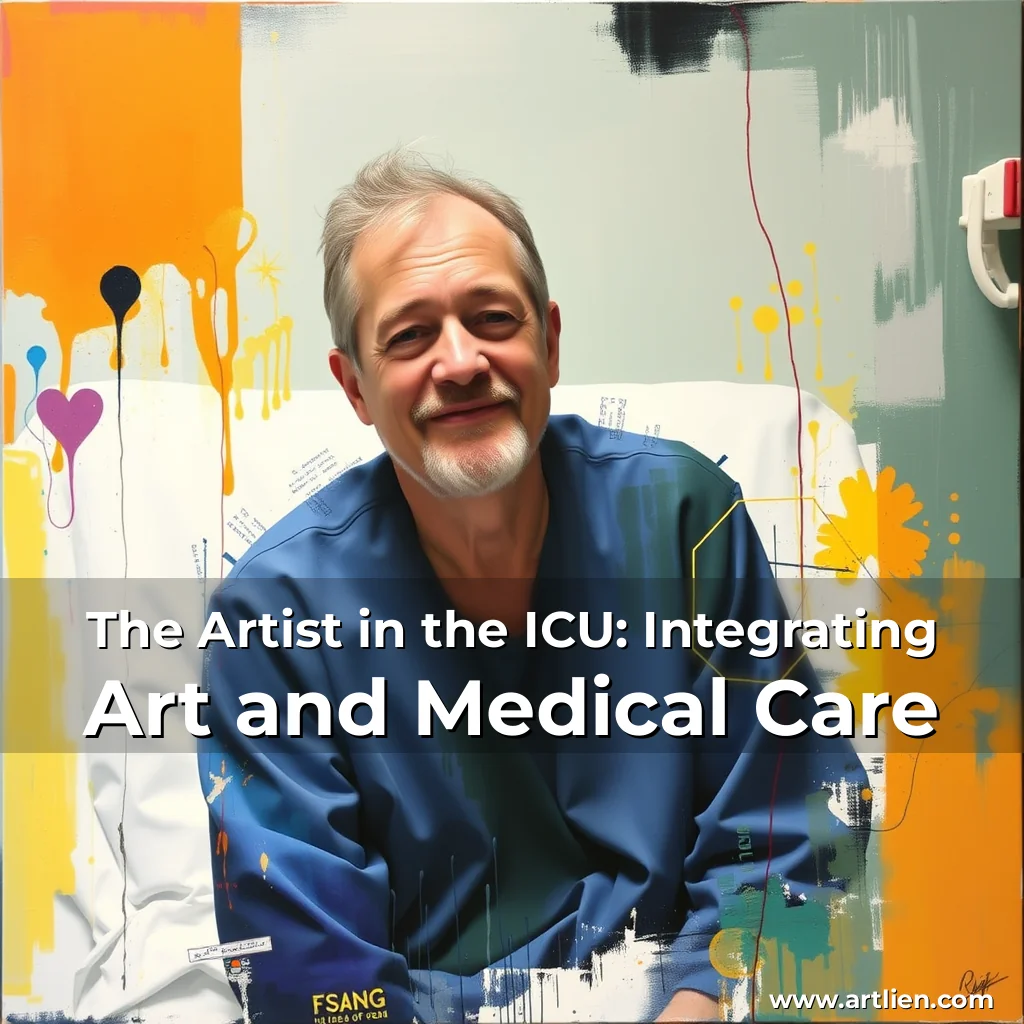
The role of an artist in the ICU may seem unconventional, but for Richard Curtis of Thomasville, it’s a vital part of his work as a medical volunteer. Curtis teaches art classes at Thomas University, but his true passion lies in end-of-life care, where he uses his artistic skills to bring comfort and solace to patients and their families. As an end-of-life doula who volunteers with patients through Archbold Hospice, Curtis has witnessed firsthand the emotional and psychological impact of illness and mortality on patients and their loved ones. His experiences have not only shaped his artistic style but also informed his approach to medicine. “Hospice is a holistic plan of care for the patient and families,” Curtis explains. “It’s a way of transitioning, a meaningful transition that gives the patient some sense of well-being that the family can be a part of.”
To illustrate his approach, Curtis showcased his recent artwork at a Medical Humanities course at PCOM South Georgia, led by faculty member Thomas Last, PhD. The course aims to help student physicians transcend the science of medicine by providing reflective opportunities and meaningful experiences that deepen their understanding of diverse patient perspectives.
- Curtis’ artwork often incorporates his hospice patients’ hands, which he draws to learn about their lives and personalities.
- The act of drawing becomes a channel for self-reflection, allowing him to explore personal experiences and emotions, which in turn cultivates a deeper sense of empathy and compassion for those facing the end of life.
- Curtis also uses pen and ink to recreate his drawings, making each one unique and reflecting his personal connection with the patient.
The students in the Medical Humanities course were deeply moved by Curtis’ presentation, which emphasized the importance of integrating art and medical care. “The Medical Humanities course supports students’ growth into humanistic, socially conscious physicians by providing reflective opportunities and meaningful experiences that deepen their understanding of diverse patient perspectives,” Last said. “Curtis’ hospice experiences and artwork resonated strongly with the first-year students by emphasizing the emotional and humanistic side of medicine, elements often overlooked in traditional medical school didactic teaching.”
During the session, Curtis shared several of his recent drawings, which were originally created with pencil and later recreated using pen and ink. He explained how he drew the hands of his hospice patients, often in collaboration with the patient themselves, to learn about their lives and personalities.
“I draw their hands because, of course, you want to maintain confidentiality, so you don’t want to draw their face. Also, their hands are so descriptive of their life. I draw their hands and learn something about the patient. Then, I will write a little bit about them. Sometimes the writing will end up on the drawing.”
After reviewing several drawings, Curtis asked the students to pair up and create a unique piece of art inspired by their partner’s memories of loved ones who had passed away. They used a cell phone’s flashlight to cast a shadow on a partner’s hand, tracing it onto watercolor paper.
| Student | Artwork |
|---|---|
| Doan Nguyen | A drawing of his grandfather’s hand, with a smile and a wave |
| Anna Beth Boyette | A drawing of her grandmother’s hand, with a subtle smile and a gentle curve |
The students were then asked to elaborate on their tracings, inspired by their partner’s memories of loved ones who had passed away. First-year student physician, Doan Nguyen, shared his experience, stating, “The act of drawing became a channel for self-reflection, allowing me to explore personal experiences and emotions, which in turn cultivated a deeper sense of empathy and compassion for those facing the end of life.”
Similarly, Anna Beth Boyette reflected on the significance of the broader picture in medicine, stating, “Drawing a hand motion that symbolized someone important to me, especially someone who had passed, was a powerful act of reflection. It made me think about how the smallest gestures—like the way someone held a hand or rested their fingers—can carry a lifetime of meaning.”
In conclusion, Richard Curtis’ artwork and approach to end-of-life care serve as a powerful reminder of the importance of integrating art and medical care. By providing a holistic and compassionate approach to patient care, Curtis’ work has the potential to transform the way we think about medicine and its role in society. As Doan Nguyen and Anna Beth Boyette aptly put it, “Every physician must navigate these delicate moments with both clinical expertise and a commitment to respect the human experience.”
Definitions:
- End-of-life care
- Hospice
- Medical Humanities
- Art in medicine
Key Takeaways
- Art can be a powerful tool in medical practice, particularly in end-of-life care.
- The integration of art and medical care can lead to a more holistic and compassionate approach to patient care.
- Self-reflection and empathy are essential components of effective medical practice.
References
- Curtis, R. (2022). The Art of End-of-Life Care. Thomasville, GA: Self-published.
- Last, T. The Medical Humanities Course at PCOM South Georgia. PCOM South Georgia, GA.
Appendix


This article highlights the importance of integrating art and medical care in end-of-life care. By providing a holistic and compassionate approach to patient care, Richard Curtis’ artwork and approach serve as a powerful reminder of the potential for art to transform the way we think about medicine and its role in society.


news is a contributor at ArtLien. We are committed to providing well-researched, accurate, and valuable content to our readers.
You May Also Like

Levitate Music and Arts Festival Returns to Marshfield MA July 12 13
Born out of a humble surf shop in New England, the Levitate Music and Arts Festival has grown into a...

AI Film Festival Debuts in Hong Kong
Over 700 filmmakers from around the world have submitted their fully-AI generated artworks to the first AI-focused film festival hosted...
Where Art Meets China
798 Art District Sets a New Standard for Global Cultural Outreach In July 2025, the 798 Art District, a cultural...
Looking at the world through a camera lens is just the beginning. this guide delves into the art of photography, offering insights into capturing stunning images. from understanding lighting and composition to mastering camera settings, this comprehensive manual is your ticket to elevating your photographic skills.
She went on to study fine arts at the University of Minnesota and later earned a master's degree in fine...