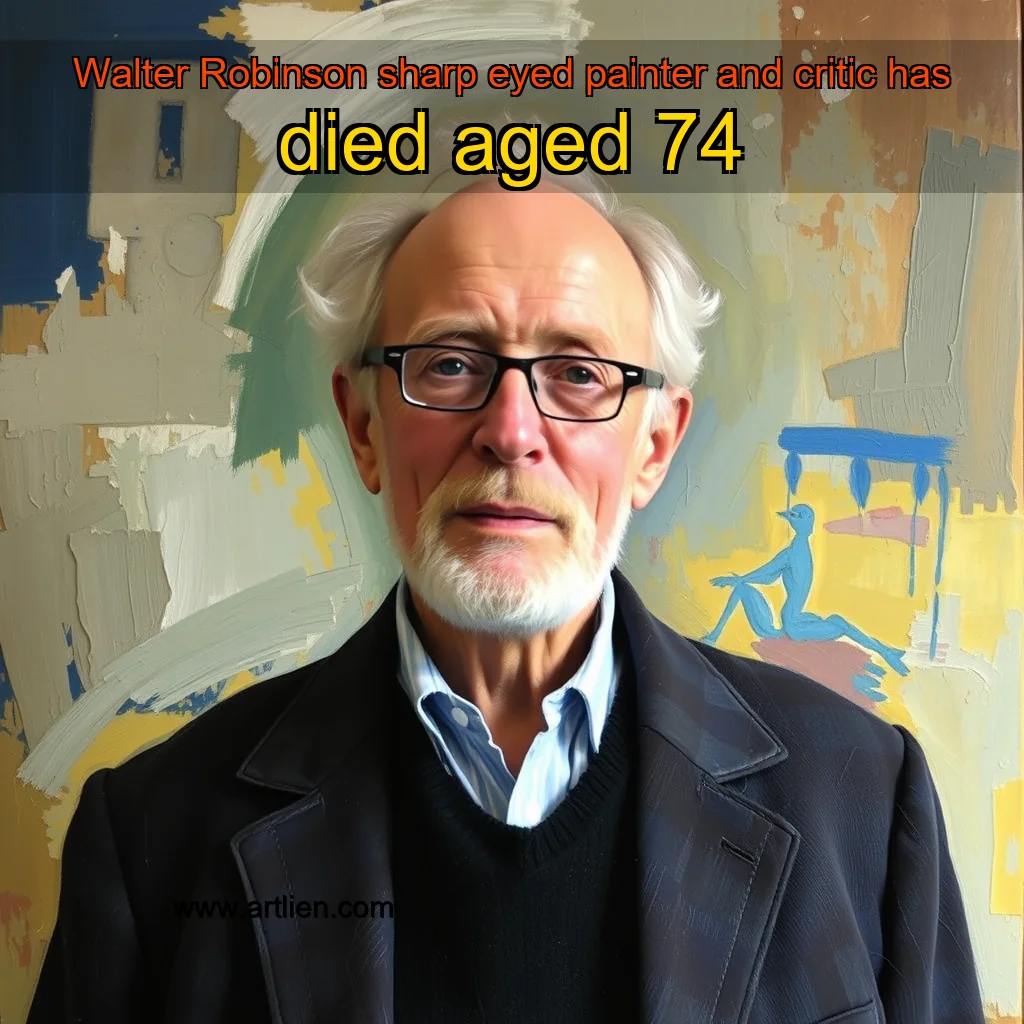
A Life of Colour and Wit
Walter Robinson was a painter known for his vibrant and humorous works, which often featured everyday people and situations. His art was characterized by its bright colours and witty commentary on modern life. Robinson’s paintings were not only visually striking but also carried a sense of irony and satire, making them both thought-provoking and entertaining.
Early Career and Influences
Robinson’s early career was marked by his work as an art critic for various publications, including The New York Times and Artforum. He was heavily influenced by the likes of Clement Greenberg and Harold Rosenberg, two prominent art critics of the time. Greenberg’s emphasis on the importance of abstraction and the role of the artist as a visionary resonated with Robinson, while Rosenberg’s focus on the artist’s role in society and the cultural context of art had a lasting impact on his writing style. Key influences: + Clement Greenberg + Harold Rosenberg + The New York Times + Artforum
The Art Critic’s Role
As an art critic, Robinson sought to challenge the conventional wisdom of the art world. He believed that art criticism should be more than just a descriptive account of a work of art; it should be an interpretation that reveals the underlying themes and ideas. Robinson’s writing style was characterized by its clarity, precision, and depth, making him a respected voice in the art world. Key aspects of Robinson’s art criticism: + Challenging conventional wisdom + Interpreting art as a reflection of underlying themes and ideas + Clarity, precision, and depth in writing style
The Whitney Museum of American Art’s Independent Study Program
Robinson’s enrollment in the Whitney Museum of American Art’s Independent Study Program marked a significant turning point in his career.
The Early Years of Printed Matter
Printed Matter was founded during a pivotal moment in the history of art, when the boundaries between art, literature, and politics were becoming increasingly blurred. The 1970s saw a surge in the popularity of conceptual art, which emphasized the idea over the physical object. This shift in focus led to a growing demand for artists’ books, which could serve as a platform for artists to explore new forms of expression.
He was inspired by the works of artists such as Norman Rockwell and Robert Rauschenberg, who pioneered the use of popular culture in their art. This style, which Robinson called “pop surrealism,” blended elements of surrealism and pop art, creating a unique visual language that reflected the anxieties and fears of the time.
The Origins of Pop Surrealism
In the 1970s, Robinson began to explore the world of pulp fiction detective novels, which were incredibly popular during the 1940s and 50s. These novels featured gritty, hard-boiled detectives and crime stories that reflected the anxieties and fears of the time.
The Art of Robinson’s Work
Robinson’s work is a testament to the power of art to transcend time and space. His paintings, sculptures, and prints are held in high esteem by art lovers and collectors around the world.
The show was known for its eclectic mix of art, music, and performance, and was broadcast on the PBS network.
The Early Years of GalleryBeat TV
GalleryBeat TV was a groundbreaking television program that aired from 1993 to 2000. During its seven-year run, the show was hosted by a diverse group of individuals, including Robinson, Paul Hasegawa-Overacker, and Cathy Lebowitz.
He was also a regular contributor to the Australian Broadcasting Corporation’s (ABC) arts program, “The Arts”.
The Rise of Robinson’s Career
Robinson’s career in the arts began to take shape in the early 2000s. He started writing for various publications, including the Australian newspaper, The Sydney Morning Herald, and the online arts magazine, Artspace. His work as a critic and journalist helped establish him as a prominent voice in the Australian arts scene.
Early Success and Recognition

news is a contributor at ArtLien. We are committed to providing well-researched, accurate, and valuable content to our readers.