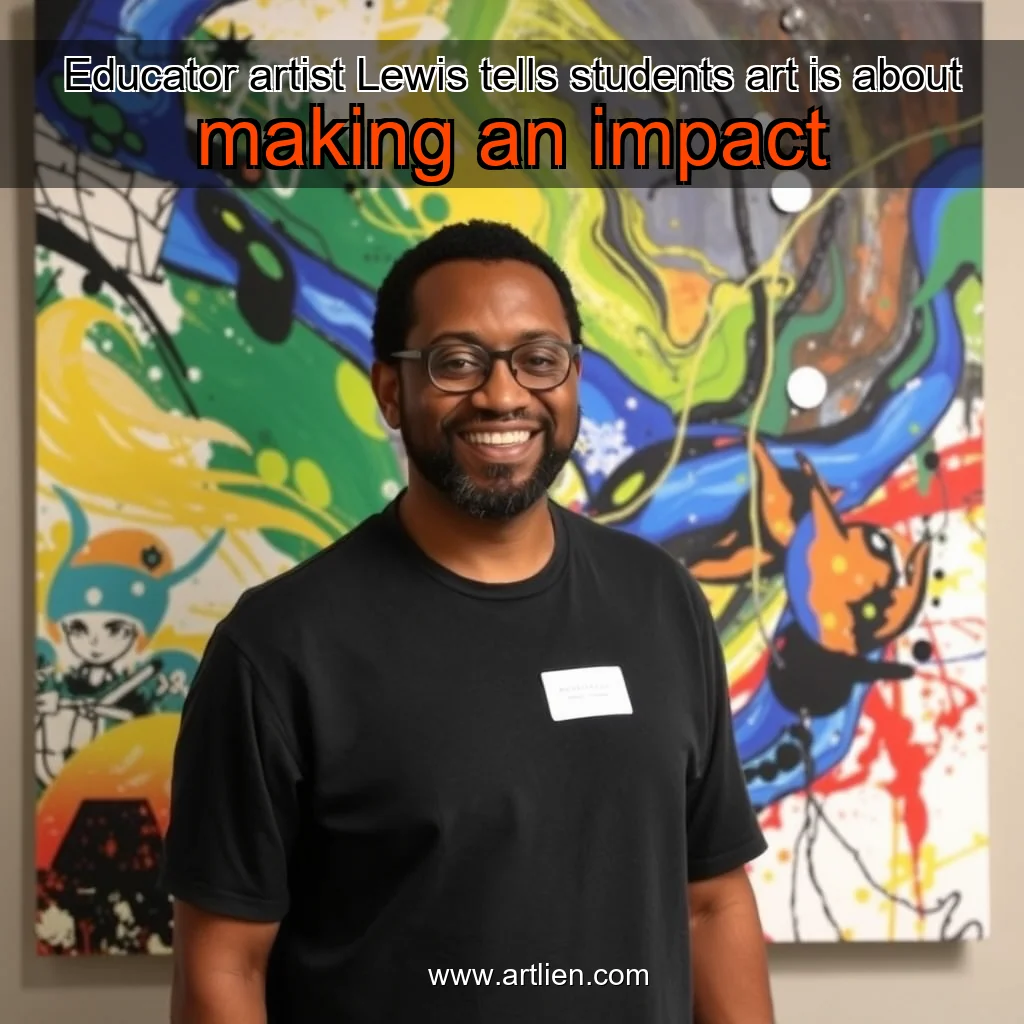
However, after a series of unfortunate events, he found himself in Owensboro, Kentucky, where he eventually settled and started his own art studio.
A Life of Art and Education
Lewis’s journey to becoming an artist and educator began in Louisville, where he was exposed to various art forms from a young age. He started drawing and painting as a child, and his passion for art only grew stronger as he progressed through school. Lewis’s early influences included the works of famous artists such as Picasso, Warhol, and Pollock.
Lewis’s work challenges this narrative by highlighting the contributions of Black Americans in other fields.
Lewis’s Artistic Vision
Lewis’s artistic vision is centered around the idea of representation and storytelling. He believes that art should be a reflection of the world around us, and that it should challenge our perceptions and broaden our understanding of different cultures and communities. Through his work, Lewis aims to give voice to the often-overlooked stories of Black Americans, and to highlight the diversity and richness of their experiences.
The Power of Representation
Representation is a powerful tool in art, as it can shape our perceptions and influence our understanding of the world. By depicting Black Americans in a more nuanced and accurate way, Lewis’s work challenges the dominant narrative that has long been perpetuated in culture. This narrative often focuses on sports and entertainment, and ignores the many contributions that Black Americans have made in other fields, such as science, technology, engineering, and mathematics (STEM). Examples of Black Americans who have made significant contributions to STEM fields include: + Mae Jemison, the first African American woman to travel in space + Dr.
“We are not seeing Black people in politics, in business, in education, in healthcare, in the arts, in science, in technology, in sports, in the media, in the military, in the government, in the judiciary, in the law, in the police force, in the fire department, in the emergency medical services, in the postal service, in the transportation system, in the construction industry, in the manufacturing industry, and in the service industry.”
The State of Black Representation in America
The United States is a melting pot of cultures, with people from diverse backgrounds living together in a complex and dynamic society. However, despite this diversity, the representation of Black people in various sectors of American life remains woefully inadequate. This lack of representation is not limited to a few isolated areas, but rather it is a pervasive issue that affects every aspect of society.
The Lack of Black Representation in Entertainment
The entertainment industry is one of the most visible and influential sectors in American society. However, when it comes to representation, Black people are woefully underrepresented. According to Lewis, we are not seeing Black people beyond entertainment. This lack of representation is evident in the fact that Black people are often relegated to stereotypical roles, such as the “angry black man” or the “sassy black woman.” These roles are not only inaccurate but also perpetuate negative stereotypes about Black people. Some notable examples of this lack of representation include: + The fact that there are only a handful of Black actors in major Hollywood films. + The lack of Black representation in television shows, with many popular shows featuring all-white casts.
“We get caught up in the day-to-day, and we forget that our stories are what make us who we are.”
The Power of Storytelling
Storytelling is a fundamental aspect of human communication, allowing us to convey emotions, experiences, and ideas in a way that transcends language barriers. It has been a cornerstone of human expression since the dawn of time, with evidence of storytelling dating back to ancient civilizations such as Egypt, Greece, and Mesopotamia.
The Benefits of Storytelling
The Importance of Telling Our Stories
Lewis emphasizes the significance of sharing our personal stories, saying, “Our stories are what make us who we are.” This idea is supported by research, which suggests that storytelling has a profound impact on our mental and emotional well-being. Reduces stress and anxiety
The Challenges of Telling Our Stories
Despite the benefits of storytelling, there are often challenges that prevent us from sharing our stories.

news is a contributor at ArtLien. We are committed to providing well-researched, accurate, and valuable content to our readers.